Connection Lost, Sanity Pending
My fellow nerds: am I the only one who struggles?
The busier I get and the more chaotic my days become, the more I’ve had to face an uncomfortable truth: the devices that were supposed to make my life easier are quietly ruining it.
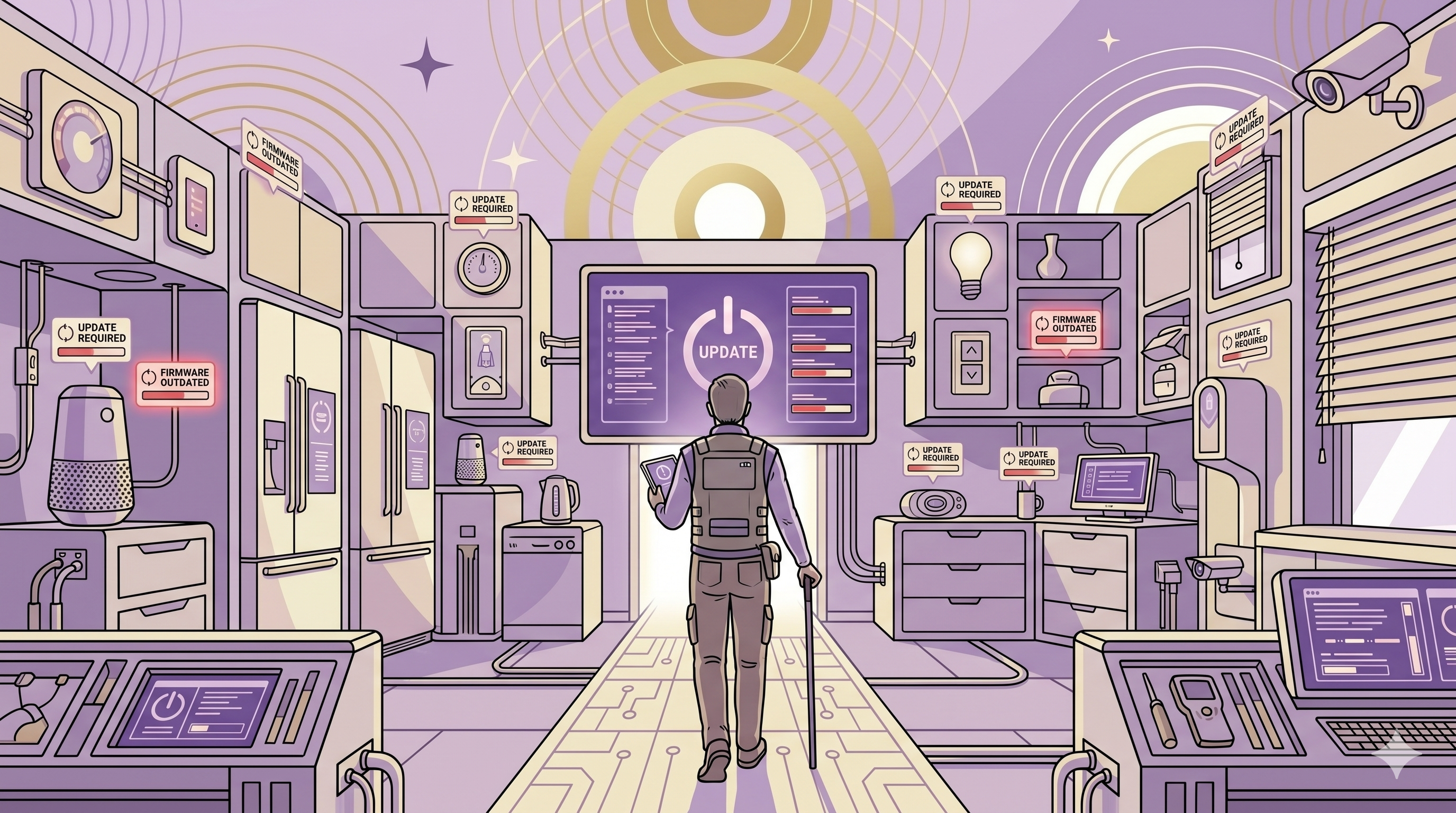
On paper, my home is very clever. Yet in reality, the robot vacuum keeps getting “stuck on the edge of a cliff” in the middle of the living room. The Zigbee motion sensors keep reporting yet another break-in. The robot lawnmower is on a personal vendetta against any dog toy left outside. And Home Assistant… let’s just say “connection lost” might as well be its love language.
Individually, none of this is a big deal. But they always seem to fail at the worst possible moment – during a call, nap time, when guests are over. I work in IT, I know how to reboot and reconfigure, and still my “smart” home makes me feel like an unpaid support technician in my own house.
The trade-off we don’t talk about
We love to pretend there’s such a thing as a free lunch with technology. There isn’t.
In theory, I’ve automated a lot of boring manual work such as vacuuming, mowing the lawn, turning lights on and off and checking who’s at the door. In practice, I’ve traded predictable, manual chores that I could plan for, for the never-ending joy of: updating firmware, debugging devices and trying to remember which app controls which device.
None of this is catastrophic. And in fact it can at times feel like a fun puzzle. But puzzles are fun when they are optional.
What happens when the puzzle is wrapped around the basics of everyday life? When the puzzle is your lighting, your heating, your front door, your baby monitor?
The hidden mental load of “smart”
The hours of maintenance don’t show up on the marketing page. They show up on our calendars, in our stress levels, and in the mental load it takes to keep everything running.
Since becoming a mother, I’m acutely aware of the background processes in my mind. I used to be a wizard at multitasking (or think I was one). But lately, and for the first time in my life I found myself in need of taking notes and making lists. On top of managing myself and my work, I am now responsable for the coreografy of a household and this is having a toal on me. This is why I find myself today talking about the way how getting more devices means I have bought myself additional headaches.
The tech that should reduce cognitive load often just moves it. Instead of one block of “cleaning”, I get dozens of tiny interruptions. Alone, they’re nothing. Together, they hijack my attention and make it harder to be present.
Because let’s face it, I have “smarted” the s*** out of my home, yet here I am in 2026, picking up toys from the floor before work so the robot vacuum can do its job while I’m gone, wondering: how did I get here?
I’m still planning, organising, anticipating – only now around the quirks of machines that were supposed to save me time.
From my living room to corporate IT
I don’t just see this at home. I see it in: corporate IT projects, public digital infrastructure, “smart” buildings and “digital workplaces”.
We call it “innovation”, but often it’s complexity dressed up as progress. But in reality, the people at the edges, front-line staff, and those in support roles – pick up the slack. They become the human glue holding shiny systems together, just like we quietly hold our smart homes together.
Smart for whom?
When we design or choose “smart” solutions, we rarely ask: smart for whom?
If you’re a manager, tech lead, or decision‑maker, you’re not just choosing tools. You’re shaping people’s mental load, frustration, and sense of autonomy.
Every new tool might mean: another password, another notification stream and another way things can fail at 16:59 on a Friday. Sometimes that’s fine. But we should at least be honest about it.
Sometimes “dumb but reliable” wins
I’m not anti‑tech. My life and career are built around it. But I am becoming more careful.
At home, I say no to gadgets I don’t want to maintain, I ask if something truly frees time, or just moves the effort, I aim for predictability over ease.
At work I push back on new tools when the team is stretched, I ask who owns the system long‑term, I look at the cost of complexity, not just features.
I keep returning to that picture of myself in 2026: a woman in tech, picking up toys before work so the robot vacuum can run, thinking: "This was supposed to free me from domestic toil. How did I end up doing extra work so the machine can work?"
I started by laughing at my robot vacuum, but underneath the jokes is a serious question about how we invite technology into our homes and workplaces – and who does the extra work when “smart” solutions create dumb problems.
Because maybe the real “smart home” – and smart workplace – isn’t the one with the most devices, but the one where the humans can breathe a little easier.
That was today’s release from the Soft(ware) Side. Until next time, your friendly human.