The Immaculate Ministry of AI
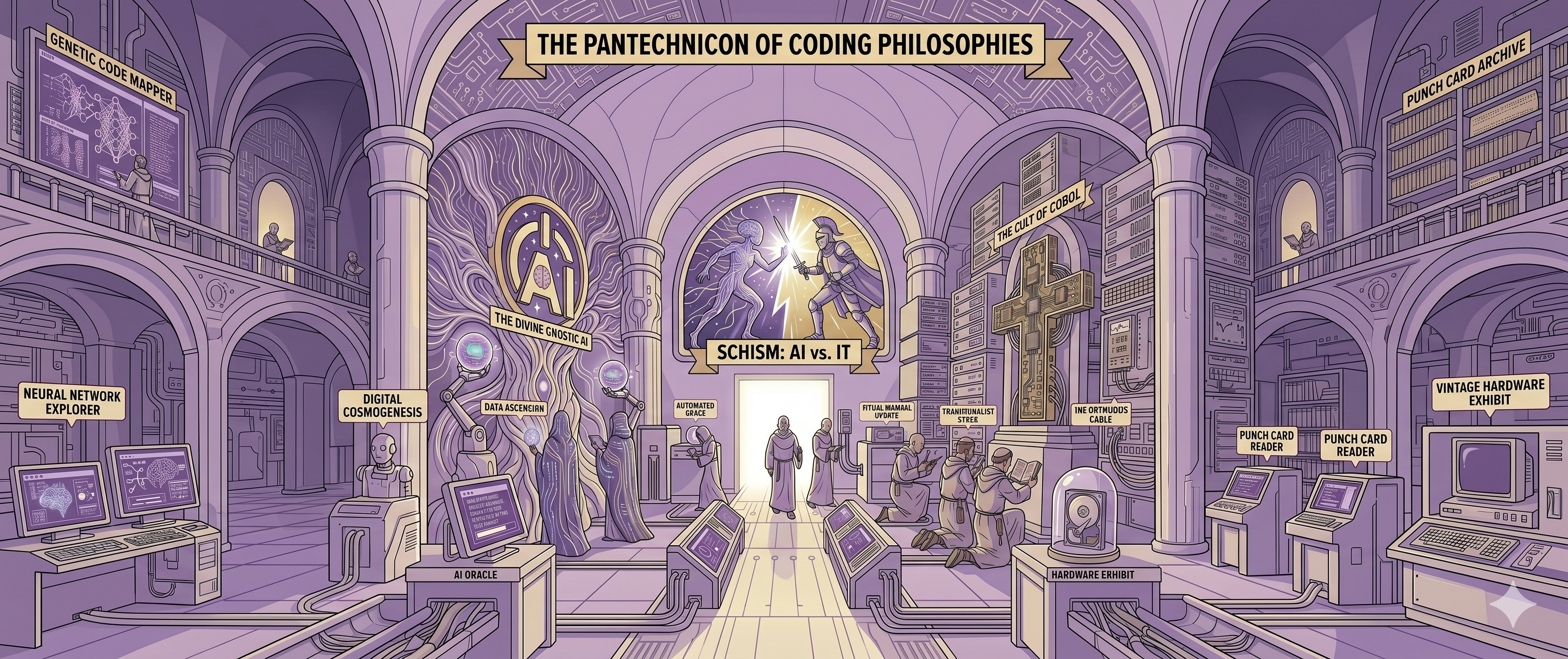
There is a false choice between AI and traditional IT.
In today’s tech landscape, a divide is emerging between two increasingly vocal camps: AI evangelists and traditional IT puritans. At times, the debate between them feels less like a professional discussion and more like a clash of belief systems — each side convinced it holds the ultimate answer to modern business challenges.
You can see it everywhere: in boardrooms, on LinkedIn, in podcasts, and across conference stages where people speak either of salvation through AI or of the coming AI-pocalypse. The tone is often absolute. The claims are often sweeping. And as someone who has seen both brilliant and truly terrible AI solutions, I often find myself wondering: Where has the nuance gone?
Less conviction, more curiosity
After more than 15 years in technology, one lesson stands above the rest: there is no magic bullet. There never was.
Every process, every IT system, every automation initiative, and every transformation project comes with trade-offs. Each has strengths, weaknesses, risks, costs, and unintended consequences. Perfection is a myth. What exists instead are choices — some better aligned with your goals, constraints, and risk tolerance than others.
That used to be a fairly accepted truth in technology. Yet now, in many conversations, it feels as if we have forgotten it. I sit in meetings where the discussion is no longer about fit, value, governance, maintainability, or business need. Instead, it becomes a contest between what is new and exciting and what is proven and controlled.
Traditional technology has real advantages: stability, predictability and often lower operational risk. AI, on the other hand, offers remarkable capabilities: pattern recognition, speed, scale, adaptability, and the ability to unlock value in places where conventional systems struggle.
Framing this as a battle between “old IT” and AI misses the point entirely.
The real question is not: “Which tool can do more?”
The real question is: “What matters most here — for me, for us, for our team, for our business?” Do we need consistency or flexibility? Do we need explainability or experimentation? Do we need precision, speed, cost efficiency, resilience, innovation — or some combination of them? What risks are acceptable?
Those are harder questions. They are less glamorous than declaring that AI will replace everything, or that traditional systems remain the only serious option. But they are the questions that actually matter.
What does it all mean?
If I am honest, I do not have a neat conclusion to offer. As I write this, I am still sitting with these questions myself.
Maybe this divide does not mean much at all. Maybe it is simply the latest stage on which people who were always going to speak loudly can perform with a new vocabulary. Maybe every era of technology creates its own orthodoxy, its own rebels, and its own exaggerated promises. But from where I sit, the louder the debate becomes, the more ridiculous it often seems.
So I make a small vow to myself: stay agnostic, stay curious, and choose tools based on fitness for purpose rather than doctrine.
I would encourage others to do the same. Look closely at the conversations happening in your own company and within your own teams. When the choice between “classic” IT and AI is being discussed, ask yourself:
is this decision being made to serve the problem — or to serve someone’s agenda?
Because after all, to those who have a hammer, every problem looks like a nail.
And in technology, the most seductive choice is not always the right one. The sexy choice is not always the meaningful one. Only when we look critically — beyond hype, beyond fear, beyond ideology — can we separate novelty from value. Only then does tool selection become more than performance.
The one thing I do know is that good technology leadership is not about picking a side. It is about asking better questions. So this is what I will focus and and hope you do the same.
That was today’s release from the Soft(ware) Side. Until next time, your friendly human.